
Questions and answers about TenderConnect
The three questions asked most often before buying — wind resistance, behaviour in a seaway and the view astern. If your question is not here, write to shop@tenderconnect.eu; we will add it.
Doesn't TenderConnect create a lot of wind resistance?
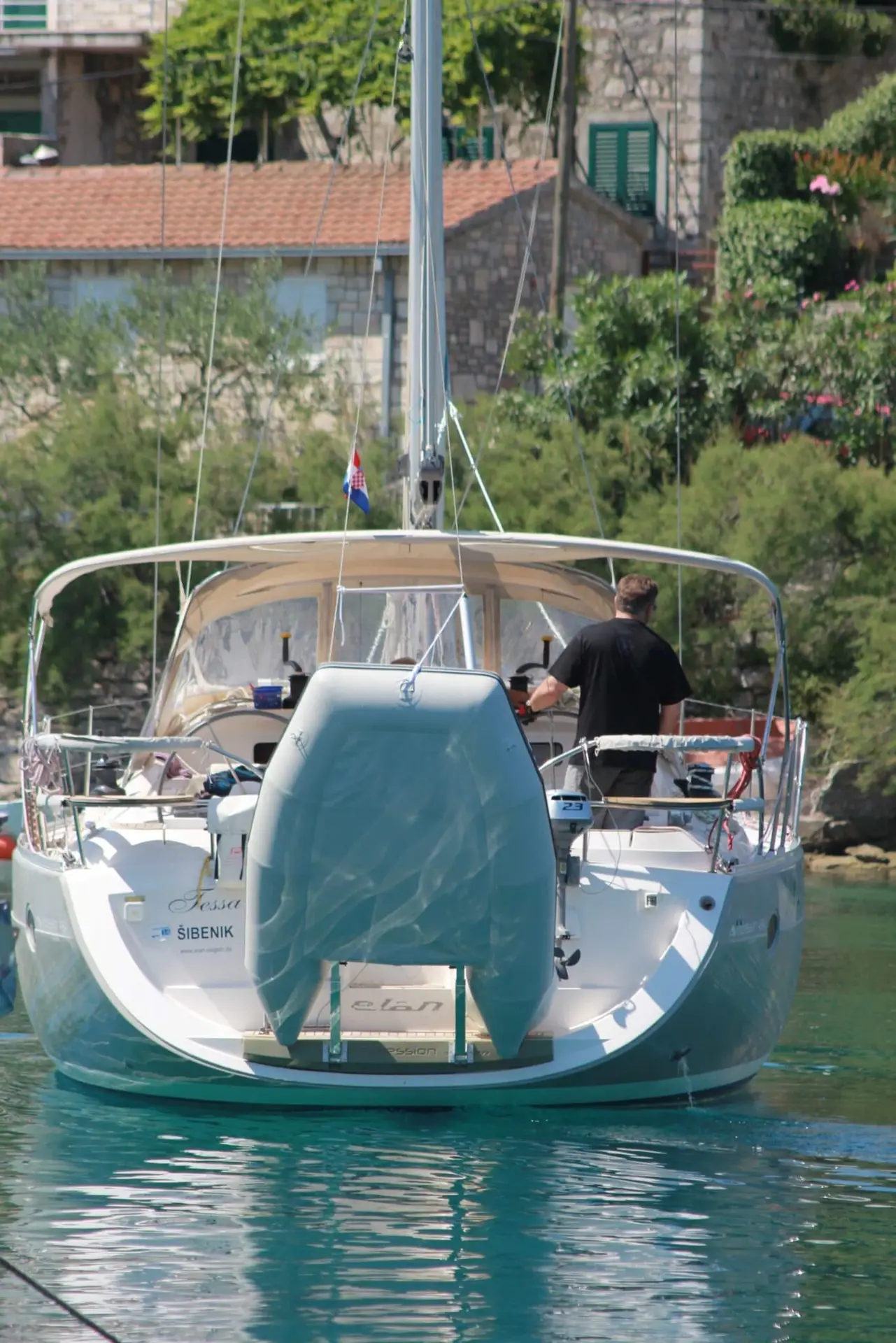
No. At least 80 % of the dinghy sits in the wind shadow of the coachroof, cockpit and stern. With headwinds as with following winds, the additional wind resistance caused by this way of carrying it is therefore negligible in every case.
The wind resistance of the whole yacht does of course increase in beam winds. These effects are not noticeable — neither when steering nor when berthing. So far only positive changes have been observed from using TenderConnect.
So there is no need to worry about any drawback. Quite the opposite: because you no longer have to worry about the dinghy, the fun increases even in stronger winds.
Does TenderConnect also work in high waves?
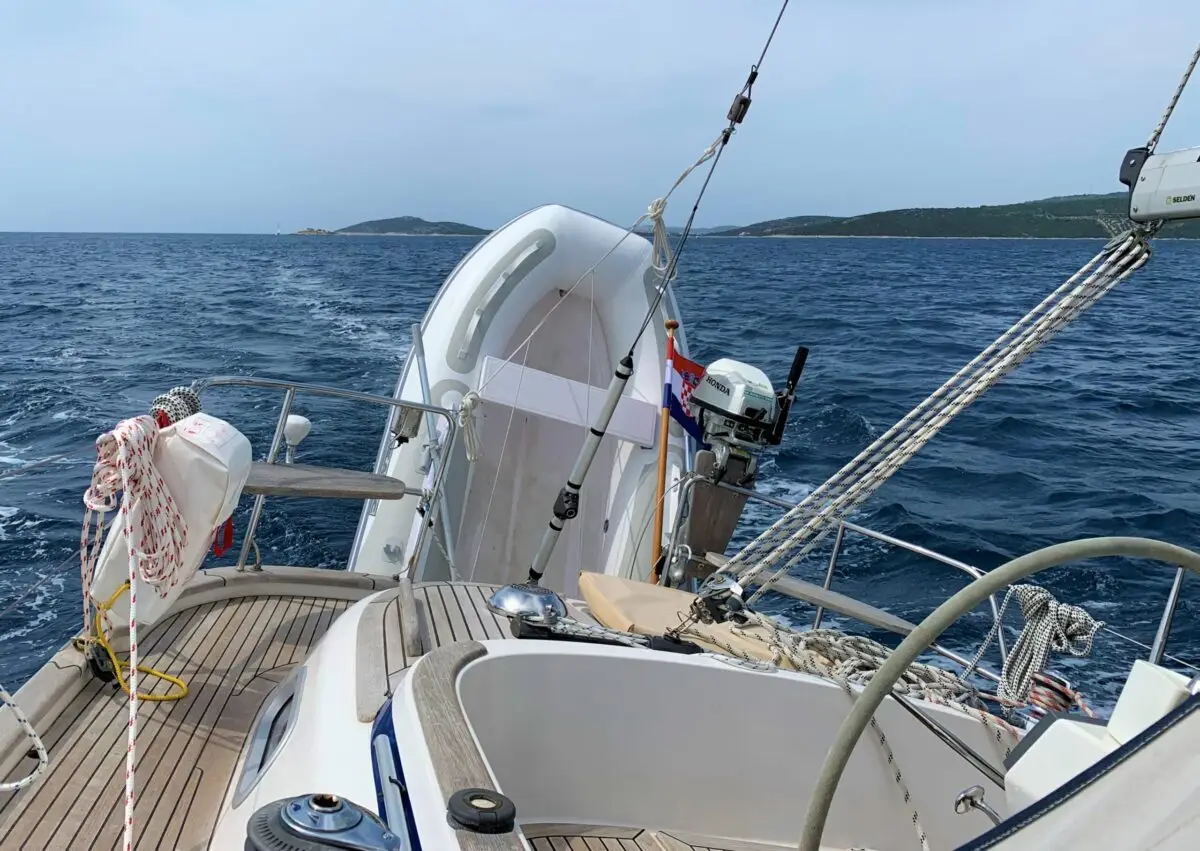
The handling of a dinghy is always affected by waves and wind — with or without TenderConnect. But when it is secured with TenderConnect, wind and sea have far less effect than with any other way of carrying it.
TenderConnect can be used without restriction in waves as well. Lowering it into the water is straightforward even in a high sea; you should simply lower it briskly. After three seconds it is unhooked.
When bringing it back up, it is best to synchronise a little with the rise and fall of the boat. You have a firm hold on the dinghy the whole time — by a line made fast to the arms on the dinghy's transom. That is what you lift it with, and that is what keeps it in step with the movement of the stern. Then simply place the arms into the receivers: from that moment the inflatable is firmly connected to the yacht. If you are reasonably brisk about hauling it up, it works very well.
For comparison, how the same thing goes with davits: there you first attach the hoisting lines at three points inside the dinghy itself — so you have to climb into the dinghy. Only then is it hauled up, with two separate tackles left and right, either by two people or alternately. With TenderConnect one person is enough.
Doesn't TenderConnect block the view astern?
Of course the view astern is restricted. But please be clear about this: Your inflatable is about 1.20 to 1.40 metres wide. From about 30 feet upwards, your yacht is between 2.80 and around 5 metres wide at the stern, depending on size. So you can look astern past the dinghy without any trouble.
With a little practice, even berthing stern-to will no longer give you any trouble.
And bear in mind: a restricted view astern is still better than a restricted view forward — which is what you get when the dinghy lies on the coachroof. It is also preferable to a dinghy on the foredeck, which causes constant problems under sail, quite apart from how hard it is to heave the dinghy on deck and lash it down so that it does not work loose in strong winds.
Your question is not among them
Write to shop@tenderconnect.eu — ideally with a photo of your stern. We will then tell you whether and how TenderConnect fits your yacht. You will find all the videos under TenderConnect in action, and the experiences of other owners under Customer reviews.


